
Updated for 2026. If you tow a travel trailer, fifth wheel, or drive a motorhome, this guide is for you: these are the RV tire pressure monitoring systems worth considering when you want early warning on pressure or temperature before a blowout. I’ll sort the picks by use case, then cover what matters when you buy.
As an Amazon Associate, RoamerLife earns from qualifying purchases.
How we ranked these
- Dedicated display versus phone app: you need to be able to read an alert without creating a distraction.
- Signal strength and repeater options for long fifth wheels, motorhomes, and coach-and-toad setups.
- Sensor type, including cap sensors versus flow-through sensors, plus expandability as your rig changes.
- Support, documentation, and the reputation owners report over time.
EEZTire is still our primary pick from real use. The other systems are compared here for their features and the kinds of rigs and drivers they fit best.
| System | Best for | Why it makes the list |
|---|---|---|
| EEZTire | Most tow setups wanting a big dedicated screen | Our pick — readable monitor, solid track record |
| TireMinder Smart | People who prefer phone/app monitoring | App-based, good if you don’t want another dash gadget |
| TST 507 | Premium, accuracy-focused buyers | Strong reputation, with flow-through options |
| Bellacorp | Higher sensor-count needs on a budget | More sensors without jumping fully premium |
| B-Qtech | Budget wireless starters | Cheaper entry; watch the support and documentation |
Start here: For most travel trailers, fifth wheels, and motorhomes that want a readable dedicated screen, get the EEZTire TPMS. Compare the others below if you specifically want app-only monitoring, more sensors, or a premium flow-through setup.
Trying to figure out the best RV tire pressure monitoring system? We’ve got you covered.
Tire safety is one of the most important parts of RVing. How many stories have you heard about people stuck on the shoulder with a blowout? Most long-time RVers will say “it’s not IF you get a blowout, but WHEN.”
The right Tire Pressure Monitoring System (TPMS) gives you a chance to react quickly to pressure or temperature swings and potentially avoid a roadside disaster.
Let’s be up front: an RV TPMS isn’t cheap. Over the life of the tires (or the rig), it’s still a smart cost — and safety — investment. Best case after a blowout, you’re buying a tire. Worst case, you’re dealing with real damage. A solid TPMS should be one of the first accessories you add.
Let’s avoid this situation.
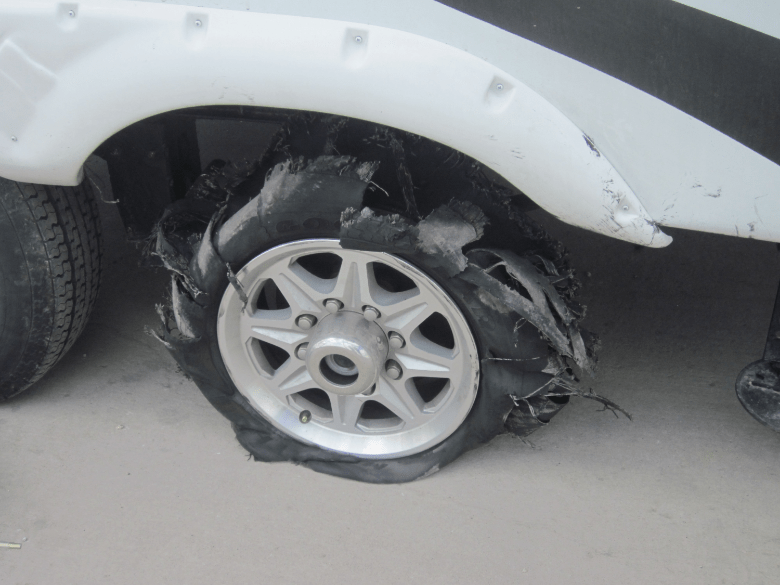
We also can’t let a good tire pressure monitoring system replace regularly inspecting your tires. But, driving down the road and being able to see changes in pressure and temperature are key in catching something before it goes significantly wrong.
Down below, we’ll get into what to look for in an RV Tire Pressure Monitoring System, but for now, let’s jump into the reviews.
Quick Navigation
Best RV Tire Pressure Monitoring System Reviews (2026)
1. EEZTire TPMS – Tire Pressure Monitoring System
Check price on Amazon (EEZTire TPMS)
Best for: Most travel trailers, fifth wheels, and motorhomes where a readable dedicated screen matters. Skip if: You specifically want all monitoring to happen in a phone app.
EEZTire remains our primary pick for many RV and trailer setups because the monitor is easy to read and the brand has built a solid track record. This TPMS monitors in real time, so you see instant updates across your tires, and if a situation occurs, you can jump on it immediately. If the pressure or the temperature get outside of your defined parameters, an alarm will sound, alerting you to the situation.
Screen size is an excellent benefit of the EEZTire TPMS. With a 3.5” screen, it’s easy to see and keep an eye on your tires. It’s a comfortably large TPMS screen. I noticed with the screen being large and clear enough, some of my more curious passengers keep an eye on the monitor as well.
Another benefit is the expandability. The system is designed to handle a larger tire count, which gives it room to grow with many tow setups. That’s plenty enough to monitor a tow vehicle with a trailer (or two), or a motorhome with a toad (whether flat tow or on a dolly), and still have room to go. So, this is a monitor that can grow with you. Maybe you only need to monitor a single-axle trailer right now, but if you ever get a double or triple axle, you don’t need a whole new system, you just need to pick up a few more sensors.
The sensors themselves have technology that turns itself off after 15 minutes of not detecting motion. However, when they detect motion again, they turn back on. So, you don’t have to worry about having the sensors drain their battery from being always on, or have to turn them on and off when you stop and start. You set them and don’t bother with them again.
I also liked the rechargeable monitor. Exact run time depends on how you use it, but charging before a trip means I don’t have cables hanging across the dash while I’m towing.
While you do need to read the manual to set things up properly, you can have them ready to go within a matter of minutes.
One last benefit to point out is EEZTire’s 3 year warranty. They have a strong warranty and offer great customer support. So, if you have any questions, you can get in touch and get them addressed.
2. TireMinder Smart TPMS
Check price on Amazon (TireMinder Smart TPMS)
Best for: App-first RVers who want phone alerts and easy setup. Skip if: You do not want to depend on a phone while towing.
TireMinder is another big name in the RV TPMS industry. They also put out a solid product and are well respected, and have won several awards from RV Magazines and publications.
I was extremely close to pulling the trigger on this being my tire pressure monitoring system of choice, but ultimately, the reliability of the EEZTire mentioned above just couldn’t be ignored. This is still an awesome system, though.
The biggest reason this one made second on my list and what almost edged it out for me when I was doing my own shopping, is the smartphone compatibility. I’m a tech nerd. I grew up with technology, I built businesses based around technology, and I’m a huge proponent of using technology to enhance our life. Being able to connect this with your smartphone is genuinely useful. For tire safety, I still prefer a dedicated in-cab display I can glance at without unlocking a phone.
The setup and adjustment of this system is really user friendly. Since it’s based in an app on your phone, it’s literally clicking the screens, changing the numbers, and it’s super intuitive. The EEZTire TPMS is super easy to program, but the TireMinder Smart TPMS takes the cake for being the easiest.
This TPMS can monitor up to 22 tires and a psi range from 0-232. It also comes with a signal booster, which is a great feature to have for longer rigs, to ensure a strong connection without interruption. Downside to a booster is having to connect it to a battery source. Again, just a few minute installation, but still another step.
TireMinder Smart TPMS still earns strong owner feedback; for our setup we stuck with EEZTire for the dedicated display and track record we already trusted.
All in, this is another great product, that tech friendly RVers will most likely love. I don’t think you will be disappointed with this system.
3. Bellacorp Tire Pressure Monitoring System
Check price on Amazon (Bellacorp tire pressure monitoring system)
Best for: Owners who need a higher sensor count without moving to a premium-priced system. Skip if: You want the longest-established support ecosystem.
This is a practical alternative from a lesser-known company in the TPMS industry. It has useful capability, although it does not have the same long-established reputation as the brands above.
The system is actually set up very similarly to the EEZTire TPMS mentioned above, so it’s quite easy to install and get your settings calibrated. But one key difference, is that it can actually monitor up to 34 tires, making it one of the more expandable options on this list.
It can monitor from 15psi up to 175psi and can check temperature up to 186 fahrenheit, so it’s more than adequate range of both pressure and temperature to fit our needs.
When I say it’s set up similarly to the EEZTire, it even has the same size screen, which you know from above, I loved. The large screen makes it easy to keep an eye on, without being overly daunting. It can sit down in the lower left corner of my windshield, dash and be there when I need to look at it.
Bellacorp still gets solid owner feedback; it just didn’t edge out EEZTire for us. They’re worth watching if you want more sensor capacity without jumping to a premium brand.
4. TST 507 Tire Pressure Monitoring System
Check price on Amazon (TST 507 tire pressure monitoring system)
Best for: Buyers who prioritize a premium-feeling system, accuracy, and flow-through sensor options. Skip if: You want the simplest, lowest-cost setup.
TST is another well known and trusted brand in this space. They were actually acquired by one of the leading companies in the tire inflation industry a couple years back. So, they have a strong history, as well as a reputable company standing behind the product.
This TPMS is a great choice for you and has many happy customers. It has a digital color display screen that is large and easy to read. It claims to be able to monitor up to 110 tires. I have no idea why you would need to monitor that many, but the capability is impressive in its own right!
This TPMS can monitor up to 218psi and temperature of 158. The temp is actually lower than others on this list, but still sufficient for our needs.
I like that this system automatically comes with a booster. Some of the others here don’t. There’s a chance you don’t need the booster, but if you get a system and do need it, it’s just another expense and wait time to get it ordered.
The main reason this one sits lower on our list is that the product information can be harder to compare across listings. While TST is well known in the space and respected, they seem to struggle with their marketing message and truly getting the full details and features out there.
This could be a good fit if you value its display and included booster; we would still compare the current documentation and support before making it your first choice.
5. B-Qtech Tire Pressure Monitoring System – Wireless TPMS
Check price on Amazon (B-Qtech wireless TPMS)
Best for: Budget-conscious owners with a smaller, straightforward setup. Skip if: You need polished documentation, broad expansion, or a very hands-off buying experience.
This is a capable budget system, but the main trade-off is the support and documentation from the company behind it. Before we get too far, let’s discuss manufacturers. Pretty much all manufacturing is done overseas, typically in China. This isn’t news. I don’t know for certain, but odds are every TPMS on this page is manufactured in China. The difference I’ve seen here is: the other companies are American companies that manufacture in China. B-Qtech appears to be a foreign company that also manufactures.
I’m all for open competition and whatever gets the consumer the best product at the best price. The problem I keep seeing pop up with B-Qtech is when it comes to the communication. Some buyers report that the instructions and customer communication are less clear than what they get from larger brands.
Now, with that out of the way, let’s talk about the actual TPMS.
Once it is set up, many owners find it works well for a straightforward wireless installation. Also, not everyone complains of the instructions being hard to understand, so I believe the user has a lot to do with this. It has a large antenna which is great for ensuring a strong signal detection without interference.
It also has a large LCD screen. The LCD screen differs from the other systems because the others simply have a dim backlit screen, while this one is a little more vibrant. It works up to 212 degrees, and up to 215psi. Again, that’s enough of a range to keep tabs on our needs.
A downside, is that it only monitors 6 tires at once. This may be enough for you, but for a lot of people, it may not be. Having the ability to monitor more tires is essential for many people. If my truck didn’t have a built in TPMS already, I wouldn’t be able to use this system because I would need to monitor 8 tires.
All in, this is a pretty good system, especially if it fits your needs and your budget better. Just be prepared that the instructions and the support could be a little below what other brands in our TPMS reviews list offer.
RV TPMS Buyer’s Guide
If you’re reading RV tire pressure monitor reviews, you may still have questions about TPMS in general. Here’s the practical buyer’s guide.
With this being not just a large financial decision, but such an important safety decision, I didn’t take it lightly. I researched, read as much as I could, talked to as many people as I could, looked online, in store, etc, until I felt like I knew everything there was to know about the subject. Then based off that info, I went with the EEZTire TPMS we discussed up above.
But for those of you that want to learn what to look for, here’s some important info to consider.
What is an RV Tire Pressure Monitoring System?
An RV TPMS is a system to designed to monitor the pressure (and usually temperature) of your tires for your RV and the tow vehicle, if applicable. There are both internal and external systems. If you’ve bought a new car in the past decade, it had an internal system, but for RVs (and for regular vehicles from 2006 or before), the easiest way to get the sensors are via external application.
You connect the external sensors to your valve stems and they provide a constant reading of your tire pressure, as well as transmit this data to a display of some sort, whether it be a standalone monitor, or your smartphone.
Why is a TPMS Important?
If you’re old enough, you may remember during the late 1990’s when there was an issue with Firestone tires having blowouts, causing rollovers, and being linked to over 100 deaths. This tragic situation led the government to enacting a law that made all car manufacturers begin using TPMS in their vehicles starting in 2007.
Tire safety is one of the most important aspects of all vehicle safety, but especially of RV safety. Many experienced RVers will tell you it’s not IF you’re going to have a blowout, but WHEN. Blowouts, aside from being expensive, and frustrating, can be extremely dangerous. A 15,000 pound trailer cruising down the highway at 70 MPH and then blowing a tire, can quickly turn into a disaster.
Most (non RV) drivers don’t even consider their tire pressure. In fact, a study found that 42% of drivers can’t identify the low air pressure symbol on their vehicles equipped with factory TPMS, and around the same number of people admitted to never bothering to check their tire pressure.
Aside from the fear factor, having improperly inflated tires will cause them to wear faster and can also hurt your vehicle efficiency. So, just from a financial perspective, these systems can pay for themselves by being able to monitor and maintain optimal settings.
Ease of Installation
Most RV TPMS are very easy and quick to install, but this is still an important factor. There is no need to make this task overly burdensome when there are so many easy to install systems available.
If for some reason a system is so complex that it recommends a professional install, it’s most likely far more complex than you need. This is truly a simple process and should not be hard.
You also may need to adjust or switch the sensors around from time to time, so ease of use and installation is going to come back as an important feature, again and again.
Reliability and Accuracy
Obviously, none of this matters if the system doesn’t work, or if you can’t trust the accuracy of the numbers. That’s why it’s important to use a reputable brand. Even then, I suggest checking it against your own tire gauge to see if there is a margin of error.
You will also need to think about the length of your unit. Some sensors and receivers are stronger than others and can stretch longer units, but for big rigs, it can often take a booster/repeater to get the signal all the way up to the monitor.
Do you need a signal booster?
For a short travel trailer, you may not need one. Long fifth wheels, a motorhome pulling a toad, and coach-plus-trailer combinations are different: the distance, metal, and bends between the farthest sensor and the display can weaken the signal. A booster or repeater is worth considering if your system supports one, especially when the manufacturer includes it or recommends it for your layout. Mount it where the instructions suggest, then test every sensor before a trip.
Monitor Readability
This is why I’m such a big fan of systems with larger screens. Being able to see the data quickly and easily is important. Being able to understand which icon on your monitor corresponds to which tire, without using a lot of thought, is key to being able to monitor quickly while you’re driving.
Final Thoughts
There’s no single best RV TPMS for every rig, but the choice gets easier when you start with how you tow. For most people who want a readable dedicated monitor and a proven all-around fit, I’d start with EEZTire. If you prefer app-based alerts and do not want another dash display, look at TireMinder Smart. If you are shopping at the premium end and value accuracy-focused features and flow-through options, TST 507 is the path to compare.
Owners with lots of sensors should look closely at Bellacorp’s capacity, while B-Qtech makes more sense as a budget starter when you are comfortable paying closer attention to setup instructions and support. Whichever route you take, set your cold pressures correctly, test each sensor, and treat the alerts as early warning—not a substitute for tire inspections.
If you’re outfitting the rest of the rig, see our best RV accessories guide for the other gear that earns space on the road.
If anything’s unclear, or you’ve run a different TPMS you love (or hate), leave a comment below and we’ll help where we can.